Choosing printed boxes is not simply a branding decision. It affects protection, shipping cost, shelf visibility, and customer trust. A box may look attractive on screen, yet arrive crushed after one delivery. That gap matters.
Industry evidence supports careful selection. McKinsey’s 2023 Global Packaging Survey found that consumers increasingly value recyclable and responsibly sourced packaging, although price and performance still influence purchases. Smithers’ packaging market research also identifies e-commerce as a major driver of demand for stronger, lighter, and more efficient formats. These findings suggest that printed boxes must balance appearance with measurable performance. A matte black mailer, for example, may communicate premium quality, but dark inks and coatings can complicate recycling in some local systems.
Use evidence, not guesswork. Check the box’s dimensions against the product, void space, and courier requirements. Request samples before approving production. Test compression, moisture resistance, print rub, and drop performance through suitable procedures, such as ISTA testing where relevant. FSC-certified paper can support responsible sourcing, but certification should be verified with the supplier. Recycling claims also require local confirmation.
There is no universal best box. A small cosmetics brand may need rigid presentation packaging, while a subscription business may prioritize lightweight corrugated mailers. My practical concern is often overlooked: beautiful printed boxes can become wasteful when oversized. Measure the product carefully. Review the artwork on a physical proof. Then compare total cost, damage risk, and disposal expectations before choosing a format that performs beyond the photograph.
How to Choose Printed Boxes for Your Products?
Product Requirements and Packaging Goals
Start with the product, not the artwork. Measure its length, width, height, and weight. Note fragile surfaces, moisture exposure, and stacking pressure. A rigid item may need a snug box, while a glass product needs internal cushioning. Define the packaging goal clearly. Is it protection, shelf visibility, easier shipping, or a premium opening experience? These goals can conflict. A heavily printed box may look attractive but add cost and recycling challenges. The U.S. Environmental Protection Agency reported that paper and paperboard packaging generated 67.4 million tons of waste in 2018, with an 80.9% recovery rate. Material efficiency still matters.
Printing choices should support real handling conditions. Select board strength for warehouse stacking and delivery movement. Choose finishes that resist scuffing when boxes rub together. Confirm color consistency across production batches. McKinsey’s 2023 global packaging survey found that 60–70% of consumers were willing to pay more for sustainable packaging. However, customers may reject packaging that feels excessive. That contradiction deserves attention.
Tips: Build one physical prototype. Drop-test it with the actual product inside. Check whether the box opens cleanly and closes securely. Ask several users to handle it without instructions. Their hesitation may reveal a design problem. Keep essential warnings and product information readable. Avoid tiny text near folds. A barcode that scans poorly is a costly oversight. My own preference would be the simplest structure that protects the product, communicates its purpose, and avoids unnecessary material. Perfect packaging is rarely perfect.

Corrugated flute thickness affects product protection, box compactness, and print performance. Thinner flutes are suitable for lightweight products and sharper graphics, while thicker flutes provide greater cushioning and stacking strength.
Representative nominal flute thicknesses: F 0.8 mm, E 1.5 mm, B 3.0 mm, C 4.0 mm, and A 5.0 mm. Actual thickness varies by paper grade and manufacturer.
How to Choose Printed Boxes for Your Products?
Box Materials, Sizes, and Structural Designs
Choosing a printed box starts with material, not artwork. Corrugated board suits heavier products and long-distance shipping. Folding carton works better for lightweight retail items. According to Smithers’ 2023 packaging forecast, the global packaging market is expected to exceed 1.3 trillion dollars by 2028. That scale increases pressure to reduce material waste. Recycled content can help, but weak board may cause crushing. A lower-material design is not always the safer design.
Size affects protection, freight cost, and customer perception. Measure the product, its padding, and its movement space. A box with excessive empty space needs more filler and may collapse during transport. A tight box can damage corners. Test the package under compression, vibration, and drop conditions. The International Safe Transit Association recommends structured performance testing for shipped products. Do not rely only on a computer model. Real handling is messier.
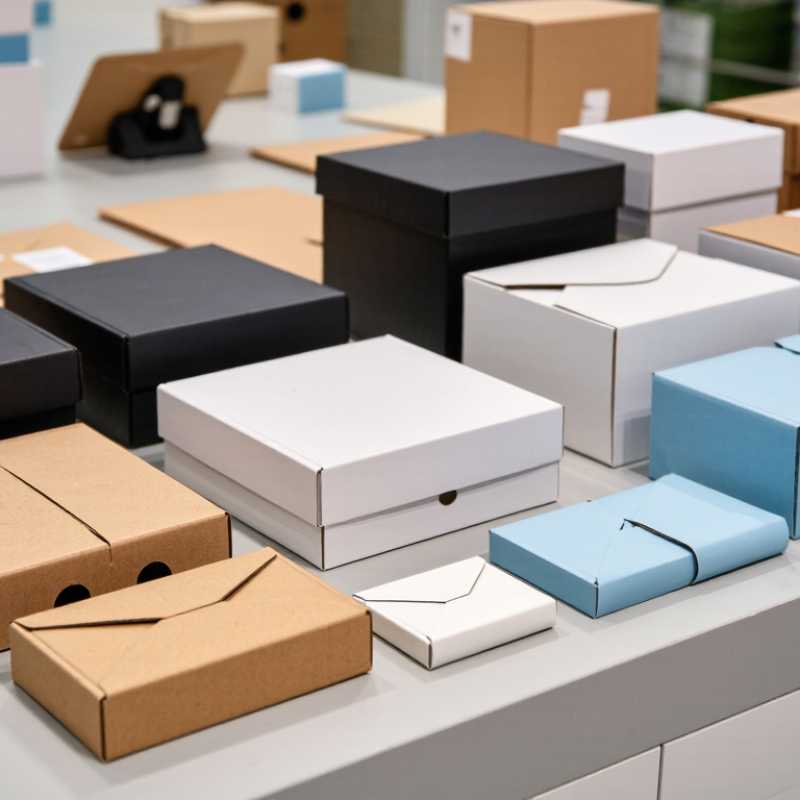
Tips: Use a material sample before approving print colors. Confirm the board grade with your converter. Consider a tuck-end carton for shelf presentation, a mailer box for easy opening, or a crash-lock base for faster packing. Structural details matter: locking tabs, crease depth, and panel proportions can change assembly time. Measure twice. Reduce ink coverage where practical, because heavy coverage can affect recycling quality. Some choices will be imperfect. A beautiful box may still waste space, while the most efficient structure may look less dramatic.

Choose the printing method according to order size, artwork detail, and surface texture. Flexographic printing suits large production runs because plates support efficient, repeatable output. Digital printing works better for short runs, seasonal designs, and multiple versions. Smithers’ Future of Digital Print for Packaging to 2028 estimates that digital packaging print will grow from about 22 billion dollars in 2022 to nearly 37 billion dollars by 2028. That growth matters for smaller product launches. It reduces unused inventory, though unit costs can remain higher.
Color needs practical testing, not personal preference alone. A deep green may look premium on screen but appear dull on recycled board. Ask for a physical proof under store lighting. Two Sides’ 2023 Trend Tracker reported that 82% of European consumers viewed paper and cardboard packaging as more sustainable. This perception can support natural tones, but green color alone does not prove environmental responsibility. Use readable contrast, especially for small ingredients and care instructions. I would not trust color alone. That judgment needs testing.
Brand elements should remain recognizable without overcrowding the box. Place the logo, product name, and one visual signature on the main panel. Repeating a pattern on side panels can improve recognition during handling. Leave quiet space around important details. Crowded packaging often weakens both shelf impact and usability. A simple mock-up may expose problems that polished artwork hides.
How to Choose Printed Boxes for Your Products?
Protection, Sustainability, and Regulatory Considerations
A printed box must protect the product before it communicates a message. In production reviews, I check compression strength, corner durability, and closure security. A beautiful package is useless if moisture softens the board during storage. Match the material to the product’s weight, shape, and delivery conditions. Small internal inserts can prevent movement, scratches, and broken edges. Test real samples, not only computer drawings.
Sustainability requires more than choosing recycled paper. Ask whether the board is responsibly sourced, recyclable locally, and suitable for the intended disposal system. Use efficient dimensions to reduce empty space and transport emissions. Limit coatings, foils, and mixed materials when they create recycling difficulties. Water-based or low-impact inks may help, but suppliers should provide clear technical information. I have seen “eco-friendly” claims become vague when documentation was missing. That is worth questioning.
Regulatory checks depend on the product, market, and packaging contact. Food, cosmetics, children’s goods, and medical products may require specific materials, declarations, warnings, or traceability records. Keep ink specifications, material certificates, test reports, and production batch details together. Printed claims should be accurate, readable, and supported by evidence. Avoid absolute statements such as “fully sustainable” without defined proof. Regulations change, and packaging teams can overlook small updates. Review requirements with a qualified local specialist before mass production. Mistakes are expensive.

| Box Material or Format | Typical Product Applications | Protection Performance | Sustainability Considerations | Printing and Finishing | Key Regulatory and Testing Considerations | Overall Selection Guidance |
|---|---|---|---|---|---|---|
| Corrugated Fiberboard Single-wall or double-wall construction |
E-commerce shipments, appliances, household goods, subscription boxes, and products requiring distribution protection. | High resistance to stacking and compression when the board grade, flute profile, and box dimensions are correctly selected. Cushioning performance depends on flute type and internal protection. | Commonly recyclable in paper streams when clean and free from incompatible coatings or excessive contamination. Recycled fiber may reduce resource use, but performance can vary with fiber quality and moisture exposure. | Suitable for flexographic, digital, and lithographic-laminated printing. Water-based coatings can be considered where moisture or scuff resistance is required. | Use distribution testing such as ASTM D4169 or ISTA procedures where applicable. Confirm paper-recycling acceptance, ink suitability, and any food-contact requirements for direct or indirect contact. | Strong all-round choice Best for shipping and higher protection needs. |


| Folding Paperboard Carton Solid bleached, coated, or recycled paperboard |
Cosmetics, dry foods, personal care products, pharmaceuticals, small electronics, and retail shelf packaging. | Good for product presentation and light-to-moderate protection. Generally needs an inner tray, pouch, or insert for fragile or heavy products. | Often compatible with paper recycling when made without plastic laminates, metallic layers, or difficult-to-remove finishes. Recycled content and recyclability claims should be substantiated for the target market. | Provides high-quality graphics, precise die-cutting, embossing, debossing, and selective coatings. Excessive foil, glitter, or plastic lamination may reduce recyclability. | For food, cosmetics, or pharmaceutical applications, assess applicable material, chemical, labeling, and product-safety rules. Packaging inks and coatings must be selected to manage set-off and migration risks. | Best for retail presentation Choose added inserts or stronger board for fragile products. |
| Rigid Paperboard Box Set-up box or premium rigid construction |
Premium cosmetics, gifts, electronics, jewelry, specialty foods, and reusable presentation packaging. | High dimensional stability and good resistance to crushing. Provides a premium structure but may be heavier and less space-efficient than folding cartons. | Fiber-based construction can support recycling, but magnetic closures, fabric wraps, foam inserts, plastic trays, and laminated papers may require separation before recycling. | Excellent for detailed printing, wrapped papers, textured finishes, foil stamping, and structural inserts. Design should avoid unnecessary mixed materials. | Check restrictions on coatings, adhesives, magnets, foams, and decorative components. If marketed as recyclable or reusable, the claim should reflect actual collection and recovery conditions. | Premium but material-intensive Use when perceived value and reusability justify additional material. |
| Molded Fiber Box or Insert Formed pulp from recycled or virgin fiber |
Protective inserts for electronics, food service items, cosmetics, bottles, and products needing shaped cushioning. | Good vibration and impact absorption when engineered to the product geometry. Moisture resistance is limited unless treated, and thin sections may be less durable in humid conditions. | Fiber-based and potentially recyclable or compostable depending on the formulation, additives, coatings, and local facilities. Compostability should not be assumed without recognized certification. | Printing is generally more limited than on smooth paperboard. Surface appearance can be improved through molded details, labels, or compatible coatings. | Verify food-contact suitability where relevant. Check whether dyes, wet-strength agents, coatings, or binders affect recycling or compostability claims. | Good protective insert option Suitable where shape-specific cushioning and fiber content are priorities. |
| Paperboard with Plastic Lamination Gloss, matte, or barrier-laminated board |
Moisture-sensitive goods, chilled products, premium cartons, and packages requiring a stronger visual finish. | Better resistance to moisture, abrasion, and surface damage than uncoated paperboard. Structural protection remains dependent on board thickness and design. | Multilayer construction can make fiber recovery more difficult. A thin coating may be accepted by some paper mills, while thicker plastic layers or composite structures may not be widely recyclable. | Supports sharp graphics and durable finishes. Lamination may improve scuff resistance but can complicate recycling and separation. | Confirm compatibility with local recycling rules and applicable extended producer responsibility requirements. Food-contact packaging requires an assessment of all layers, inks, adhesives, and coatings. | Use selectively Choose only when barrier or durability benefits outweigh end-of-life limitations. |
| Paperboard with Water-Based Coating Protective aqueous coating |
Retail cartons, food packaging, promotional boxes, and products needing moderate scuff or moisture resistance. | Improves surface durability and resistance to light moisture or rubbing. It is not a substitute for a moisture-barrier structure in demanding environments. | Often more compatible with paper recycling than plastic film lamination, but actual recovery depends on coating weight, chemistry, and local mill acceptance. | Compatible with many printed designs and can provide matte, gloss, or soft-touch effects. Coating selection should be confirmed with the printer and recycler. | Review chemical compliance, food-contact suitability, drying performance, and set-off control. Avoid unsupported claims such as “fully recyclable” without market-specific evidence. | Balanced option Useful when moderate surface protection is required without a separate plastic film. |
| Reusable Plastic Box Rigid polypropylene or polyethylene format |
Returnable distribution systems, durable storage packaging, industrial components, and repeated-use applications. | High resistance to moisture, impact, and repeated handling. May offer stronger protection over multiple cycles than disposable fiber packaging. | Reuse can reduce packaging impacts when the box completes enough cycles and return logistics are efficient. Recycling depends on polymer type, additives, color, and collection infrastructure. | Printing may require labels, sleeves, direct printing, or molded-in identification. Decorative labels and mixed materials should be designed for removal or compatibility with recycling. | Confirm polymer identification, chemical compliance, food-contact status where applicable, and cleaning or reuse requirements. Validate the complete return system rather than the container alone. | Best for closed-loop reuse Less suitable where return rates and collection systems are uncertain. |
Cost should begin with total cost, not the carton price alone. Add plates, color matching, tooling, freight, storage, and damaged-product claims. A cheaper box can become expensive after compression failures. Smithers estimates the global packaging market exceeded 1 trillion US dollars in 2023, showing how small sourcing decisions can scale quickly. Request quotations at several order quantities. Compare the price at 1,000, 5,000, and 20,000 units. Check whether the supplier includes sampling and artwork adjustments.
Supplier selection needs evidence. Ask for material specifications, production photographs, and recent test records. Confirm board grade, paper weight, coating type, and printing tolerance. A capable supplier should explain its quality process clearly. It should also provide a pre-production sample for approval. Do not approve only from a digital image. Screen brightness can hide weak color matching. Packaging sustainability matters, but claims need proof. A 2023 McKinsey consumer survey found that roughly 60–70% of respondents were willing to pay more for sustainable packaging in selected categories. Consumer interest is real, but higher cost still requires measurement.
Test the box in conditions close to actual delivery. Use edge crush or compression testing for stacking strength. Use drop testing for filled cartons. Consider humidity exposure, especially for paper-based packaging. ISTA test procedures can provide a structured transport-testing reference. Inspect color consistency with measured values, not eyesight alone. Small defects matter. Yet perfect laboratory results do not guarantee a perfect shipment. Review failed samples honestly, adjust the structure, and test again before mass production.
We offer Packaging Boxes delivered to your door. Secure, professional, and affordable, our custom made packaging boxes are guaranteed to protect and transport your valuable items. Our devoted team is always there to serve you.