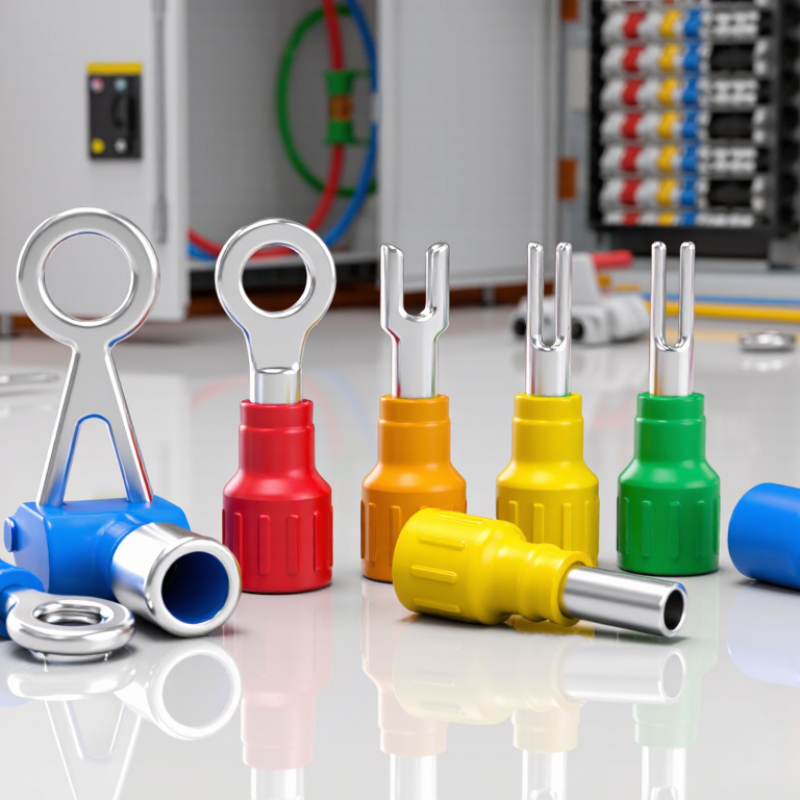
| Ring Tongue Lug | Approximately 0.25–6 mm² for common insulated versions; larger sizes are also available. | Usually stranded copper; tinned copper versions are common for improved corrosion resistance. | Electrolytic copper, frequently tin-plated. | PVC, nylon, or polycarbonate depending on the product series. | Commonly 75–105°C; verify the specified insulation system. | Control panels, automotive harnesses, appliances, industrial wiring, and grounding connections. | The closed ring remains attached if the screw loosens partially. It provides stable mechanical retention and reliable electrical contact when correctly crimped. | Requires complete screw or stud removal for installation. Hole diameter and stud size must match accurately. | UL 486A-486B may apply to listed wire connectors and terminals. IEC 61210 may be relevant to connecting devices for copper conductors. RoHS and REACH requirements may apply in regulated markets. | Check stud-hole diameter, wire-size range, barrel length, insulation support, crimp profile, and approved conductor class. |
| Fork or Spade Lug | Approximately 0.25–6 mm² for common insulated versions. | Stranded copper, commonly tin-plated for general-purpose electrical use. | Stamped copper alloy or copper with tin plating. | PVC, nylon, or polycarbonate. | Commonly 75–105°C, subject to insulation and certification. | Terminal blocks, relays, switches, control equipment, and serviceable wiring assemblies. | Can be installed without fully removing the fastener. Suitable for applications requiring quick maintenance access. | Less resistant to pull-out or side-loading than a closed ring if the connection is not properly secured. | UL 486A-486B can be relevant for listed terminals. Product-specific pull-out, temperature-rise, and current tests should be reviewed. | Confirm fork geometry, tongue thickness, screw compatibility, anti-rotation features, and resistance to vibration. |
| Pin Terminal Lug | Approximately 0.25–6 mm² for common insulated versions. | Stranded copper, often tin-plated. | Copper or copper alloy, commonly tin-plated. | PVC, nylon, or polycarbonate. | Commonly 75–105°C, depending on the insulation material. | Compact terminal blocks, push-in terminals, circuit-breaker accessories, and narrow connection points. | Provides a narrow, rigid insertion point and helps prevent strand spreading in screw or spring terminals. | Usually has lower flexibility at the connection point than a bare stranded conductor. Must match the terminal opening and clamping method. | IEC 61210 may be relevant for connecting devices using copper conductors. Terminal block and equipment standards may impose additional requirements. | Check pin diameter, insertion depth, conductor cross-section, insulation clearance, and compatibility with the receiving terminal. |
| Butt Splice Terminal | Commonly 0.5–6 mm² for insulated crimp splice versions. | Stranded copper conductors joined end-to-end. | Copper or copper alloy barrel, often tin-plated. | PVC, nylon, or heat-shrink polyolefin for sealed designs. | Approximately 75–125°C; heat-shrink versions may offer higher environmental protection but require product verification. | Harness repair, cable extension, automotive wiring, machinery, and control-circuit assembly. | Creates an in-line electrical and mechanical joint without a separate terminal stud or screw. | Requires correct stripping length and a calibrated crimp. A standard insulated butt splice is not automatically waterproof. | UL 486A-486B may apply to listed wire connectors. IP or environmental claims require testing of the complete assembled splice. | Prioritize barrel length, wire-size range, crimp-tool compatibility, insulation recovery, and moisture-sealing requirements. |
| Heat-Shrink Ring Lug | Approximately 0.5–16 mm² in common industrial and automotive ranges. | Stranded copper, usually tin-plated for improved resistance to oxidation. | Annealed copper or copper alloy with tin plating. | Cross-linked polyolefin heat-shrink insulation, often with hot-melt adhesive in sealed designs. | Commonly 105–125°C; some designs are rated higher. | Marine, automotive, outdoor equipment, battery systems, and applications exposed to vibration or moisture. | Provides strain relief and improved protection against moisture, salt spray, abrasion, and conductor flexing when properly recovered. | Requires a controlled heat source and correct shrink temperature. Excessive heat can damage insulation or nearby components. | UL 486A-486B may be applicable to listed terminals. IP, salt-spray, flame, and environmental ratings must be confirmed for the specific construction. | Check adhesive type, recovered-wall thickness, sealing range, heat-shrink ratio, stud size, and installation temperature. |
| Nylon-Insulated Terminal Lug | Approximately 0.25–6 mm² for common ring, fork, and pin configurations. | Stranded copper; tin-plated conductors are widely used. | Copper or copper alloy, commonly tin-plated. | Nylon, typically selected where improved toughness and abrasion resistance are required. | Often around 105°C, depending on the nylon grade and certification. | Industrial controls, machinery, transportation equipment, and high-vibration wiring. | Generally tougher and more abrasion-resistant than standard PVC insulation. The insulation sleeve can provide useful strain relief. | Some nylon grades absorb moisture, which can affect dimensional or electrical properties. Temperature and chemical resistance are grade-specific. | UL 94 flammability classification, UL 486A-486B listing, RoHS, and REACH may be relevant depending on the market and product claim. | Verify nylon grade, flammability rating, operating temperature, chemical exposure limits, and crimp-tool requirements. |
| PVC-Insulated Terminal Lug | Approximately 0.25–6 mm² for common commercial and industrial sizes. | Stranded copper, commonly tin-plated. | Copper or copper alloy, generally tin-plated. | Flexible PVC insulation. | Commonly 75–105°C, depending on the formulation and approval. | Indoor control panels, appliances, lighting equipment, and general low-voltage wiring. | Cost-effective, flexible, and widely available in color-coded wire-size ranges. | Compared with specialized materials, PVC may have lower high-temperature, abrasion, solvent, or low-temperature performance. | UL 486A-486B, UL 94, RoHS, REACH, and applicable national wiring requirements should be checked against the product documentation. | Confirm temperature rating, flame classification, plasticizer compatibility, insulation grip, and suitability for the installation environment. |
| High-Temperature Insulated Lug | Commonly 0.5–6 mm², with larger sizes available for specialized equipment. | Stranded copper; nickel-plated or nickel-based components may be used in severe-temperature designs. | Tin-plated copper for moderate service or nickel-plated copper for elevated-temperature environments. | High-temperature nylon, polyamide, silicone, PTFE, or other engineered insulation, depending on design. | Approximately 125–200°C for selected products; never assume the rating without certification data. | Ovens, industrial heaters, engine compartments, power electronics, and high-temperature machinery. | Maintains insulation and mechanical performance at temperatures above common PVC-lug limits. | Usually more expensive and may require specialized stripping, crimping, or installation procedures. | UL, IEC, temperature-index, flammability, and equipment-specific requirements should be evaluated together. The terminal rating cannot exceed the weakest component in the connection. | Review continuous and short-term temperature ratings, thermal aging data, plating compatibility, and clearance requirements. |
| Pre-Insulated Cord-End Ferrule | Approximately 0.14–50 mm², depending on single-conductor or twin-conductor design. | Stranded copper conductors; the ferrule is usually electrolytic copper. | Tin-plated copper barrel with a polymer collar. | Polyamide or other insulating polymer collar. | Commonly 105°C or higher, subject to product approval. | Fine-stranded wires inserted into screw, spring, or push-in terminal blocks. | Consolidates fine strands, improves insertion, and reduces strand damage or strand escape under clamping. | Not a substitute for a ring or fork lug where a stud connection is required. The terminal must be designed to accept ferrules. | IEC 60999 and IEC 61210 may be relevant depending on the connection system. Local panel-wiring and terminal-block requirements may also apply. | Check ferrule length, pin diameter, single or twin configuration, conductor class, and compatibility with the terminal clamp. |
| Battery and Power Ring Lug | Commonly 6–70 mm², with larger cross-sections available for high-current systems. | High-conductivity copper, often tin-plated; aluminum versions may be used for selected cable systems. | Heavy-wall copper, tinned copper, or approved bimetallic construction for copper-to-aluminum transitions. | Usually polyolefin, PVC, nylon, or heat-shrink polyolefin insulation. | Commonly 85–125°C; high-temperature designs require separate verification. | Battery banks, inverters, starter circuits, photovoltaic systems, grounding conductors, and power distribution. | Supports higher current than small control-wire terminals when correctly sized, crimped, and installed. | Incorrect crimping, undersized cable, poor surface preparation, or loose fastening can cause high resistance and overheating. | IEC 61238-1 may be relevant to compression and mechanical connectors for power cables. UL 486A-486B and equipment-specific standards may also apply. | Verify cable cross-section, continuous and short-circuit current, stud size, barrel dimensions, crimp die, plating, and corrosion environment. |
| Bimetallic Insulated Lug | Commonly used with larger aluminum or copper conductors, typically above 16 mm². | Aluminum conductor with copper interface, or an engineered copper-aluminum transition. | Friction-welded or otherwise qualified bimetallic body, often with tin-plated contact surfaces. | Polyolefin, PVC, nylon, or heat-shrink insulation depending on the product design. | Commonly 90–125°C; product-specific thermal limits are essential. | Power distribution, photovoltaic arrays, utility equipment, and copper-to-aluminum cable transitions. | Helps manage galvanic and compatibility concerns when connecting dissimilar conductor materials. | Requires strict attention to conductor preparation, oxide removal, joint compound requirements, crimp tooling, and installation torque. | IEC 61238-1 is commonly considered for power connectors. Additional utility, photovoltaic, or national electrical requirements may apply. | Confirm conductor material, transition design, approved die, oxide-inhibiting compound requirements, temperature rating, and certification scope. |
| Flag or Right-Angle Insulated Lug | Approximately 0.5–6 mm² for common harness and control applications. | Stranded copper, commonly tin-plated. | Stamped copper or copper alloy with tin plating. | PVC, nylon, or polycarbonate. | Commonly 75–105°C, depending on the insulation system. | Compact wiring harnesses, automotive connectors, appliances, and restricted-access terminal locations. | Changes the cable exit direction, helping reduce bending radius and save space in crowded assemblies. | Mechanical stress can be concentrated at the bend if the harness is unsupported. Orientation must match the assembly layout. | UL 486A-486B, UL 94, RoHS, REACH, and equipment-specific vibration requirements may be relevant. | Check orientation, bend angle, terminal clearance, strain relief, wire-size range, and resistance to vibration. |